
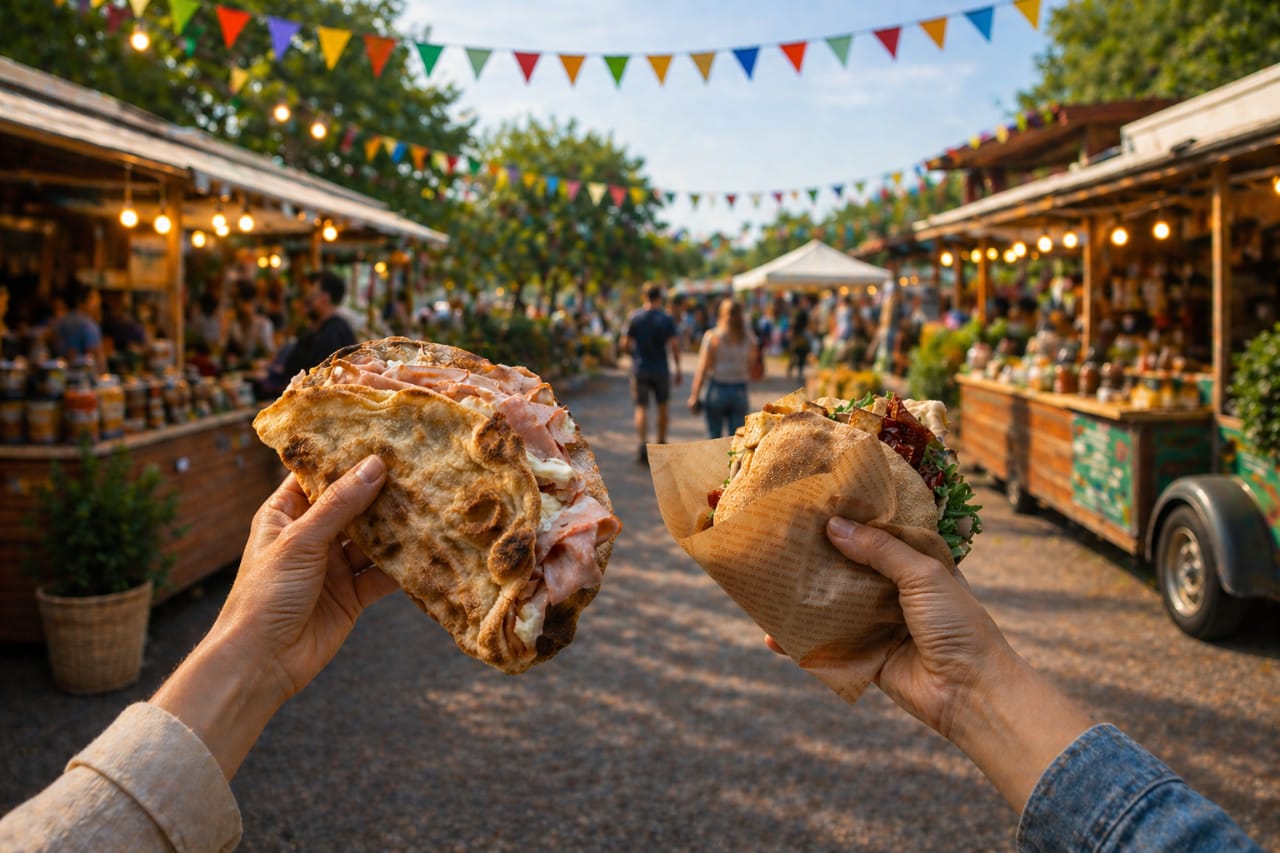
With the arrival of warm weather, the calendar fills up and for those working in the restaurant industry, events become a business opportunity. Indeed, summer events concentrate audiences, consumption opportunities and visibility.
The point, however, is not to participate: Is to be able to emerge.
Street food and events: an opportunity not to be missed
The opportunity related to summer events is always relevant, but in some contexts more so. In Italy, according to the Ministry of Tourism, there are more than 4,000 events each year, including concerts, festivals, sports events and cultural initiatives, capable of attracting about 30 million visitors between June and September.
In parallel, Street food market also grows: In Italy, there are an estimated 3,000 active operators and a turnover close to 2.5 billion euros annually, but the dynamic is found throughout Europe, where events and street food reinforce each other. Some cities have become real landmarks: Berlin, for example, is often considered one of the iconic street food cities thanks to initiatives such as the Street Food Thursday Berlin, While London hosts established formats such as the Taste of London.
The result is simple: more demand, but also much more supply.
To be successful, you have to differentiate yourself
Always, competition has been about the ability to stand out, but today it is more difficult to do than a few years ago. Not only because the average quality level has risen, but because the very nature of street food has changed.
In recent years, in fact, some clear trends have emerged:
- the spread of gourmet food truck;
- the birth of thematic festivals dedicated to street food, such as those mentioned above;
- the entry of operators with structured catering background.
In many contexts, street food is no longer the answer to the need to eat quickly during an event, but becomes a reason for attraction. This, however, changes the rules of the game, because the operator no longer serves a need, but competes for a choice.
Thus, beyond raising the quality of supply, how to do it?
Short, accessible and innovative menus
The menu must be readable in seconds. Too many options slow down choice and complicate service at peak times. Reducing does not mean limiting, but Make the proposal clearer and more effective. It can be very useful Flanking the physical menu with a QR code, so those in line or walking by can consult it ahead of time-a little trick that speeds up decisions and improves flow.
Thinking for peak workloads
Each dish goes Designed to hold high volumes. If it only works when you have little tail, it doesn't really work. The quality has to remain stable even in the most intense moments.
Caring for perception
The choice is made before tasting. Name of dishes, visual appearance, presentation: everything contributes to the customer stopping in front of the booth instead of next door.
Streamline processes
Fewer passes, fewer mistakes, more speed. Good internal organization translates directly into better service and greater ability to manage flow.
Starting with the product to differentiate: Pinsa, Puccia and Sorriso
The advice seen so far is essential, but they all work downstream. Upstream, there is an even more important choice to be made: what products offer.
For years, street food was synonymous with a few standard options, from sandwiches to piadinas, with very limited variations. This is no longer the case today, and it's really the product that makes the difference, attracting the customer before communication, speed of service or ability to handle peaks.
In an environment where everyone works better, starting from a different base can create an advantage, and this is where the Di Marco offer comes into play in a concrete way.
Pinsa Di Marco: fast, versatile and delicious
In the world of street food, Proposing the Pinsa Di Marco is a distinctive choice, because Pinsa is a well-known product, but not inflated like pizza or piadina. This allows it to maintain a strong attractiveness, which is particularly useful at events, where people make decisions in seconds And what strikes makes all the difference.
Operationally, the basis for catering (classics, multigrain And round), also available frozen with 18-month storage, help to Better manage inventory and reduce waste. In addition, the different formats, from snack to XL, make it easy to adapt the offering: from the quick portion to eat on the fly, perfect for street food, to solutions for sharing.
The real strength is the balance between speed and perception: in just a few minutes you get a finished product that can be easily also positioned in a gourmet key, working on ingredients and presentation. And for those who want to push even harder on identity, there is the option of starting with flours, strengthening the craft component And also taking action on food cost.
Puccia: practical, manageable, designed for street food
La Puccia was created to work during events. It is made with Pinsa dough, so it maintains lightness and digestibility, but in a format designed to be Easy to handle, stuff, and eat while standing or on the go. It is a solid base from which to start, especially when a practical, fast, and thoughtfully designed street food proposition is needed.
The Puccia also holds rich fillings well without becoming uncomfortable or unmanageable, something that often happens with traditional sandwiches. This makes it ideal in busy settings where the customer is looking for something good but also practical.
From an operational point of view, the Puccia helps to work more smoothly: standard preparations, fewer steps and faster service, without giving the idea of a trivial or obvious product. If thought out with the right combination of ingredients (i.e., avoiding those that are too moist), Can also be prepared in advance, further facilitating peak management.
Smile: fast, simple, but also innovative
Also the Sorriso comes from the dough of Pinsa, but is designed specifically for street food. Basically, it is a Pinsa already closed, ready to be stuffed and served.
This changes a lot at the operational level: it reduces steps, makes preparation faster, and allows you to Work with continuity even when the pace picks up. At the same time, the format helps to maintain order and cleanliness in the filling, avoiding dispersion and making the product easier to handle.
The small dimensions are. another strong point: they facilitate portion control, help limit waste, and open up the possibility of Build mini-menus, combinations or tasting proposals. Again, by choosing suitable fillings, it is possible to anticipate part of the preparation, making the service even faster at busy times.
Finally, precisely because it is less common than many other formats, it introduces an additional element of novelty that may intrigue and prompt purchase.


 IT_IT
IT_IT  EN
EN  FR
FR  DE
DE  ES
ES