
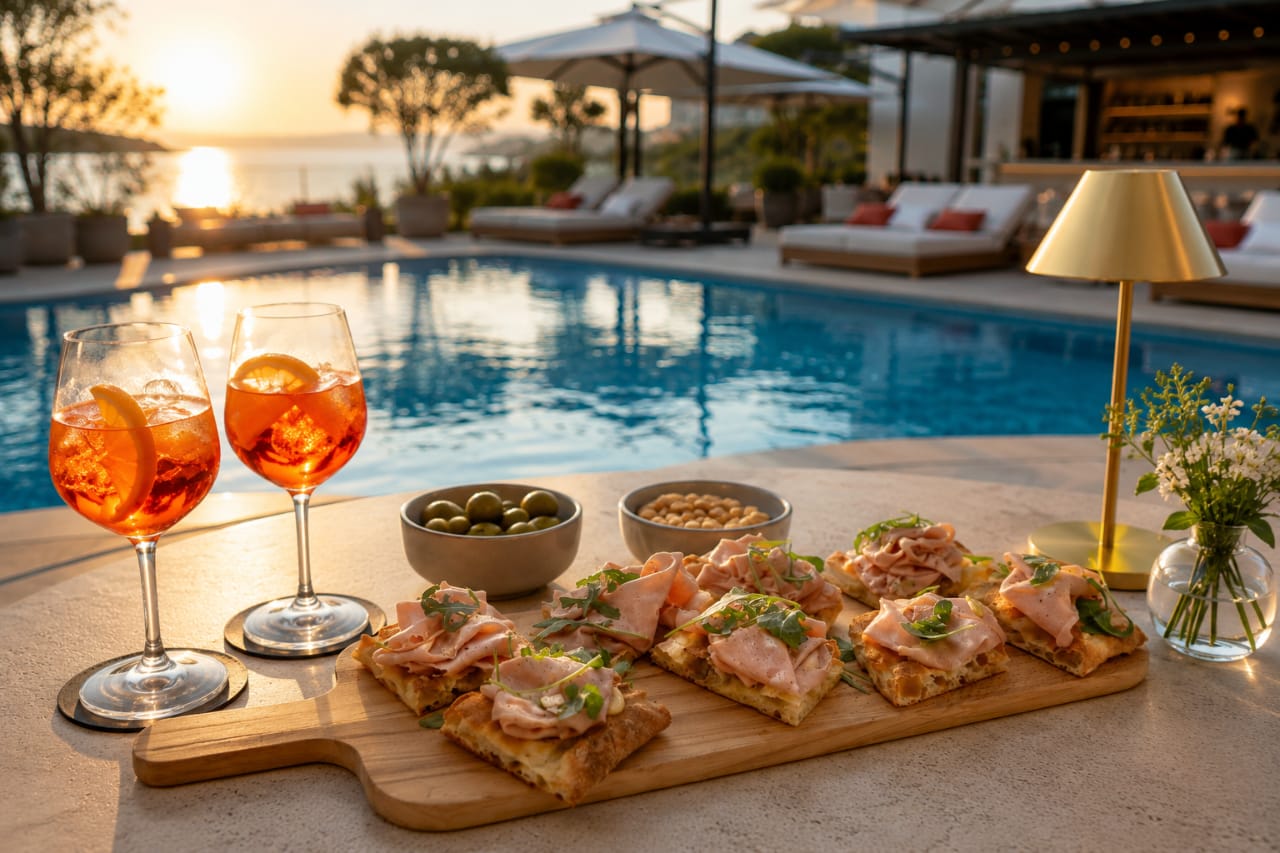
In hotels, resorts, and other lodging facilities, Food service is not an ancillary service. Even when it is not the core of the business, it still affects the guest experience, the perception of the property, and the ability to generate additional revenue.
This is no small challenge, because the food offerings must cover a wide range of situations: Quick lunches, aperitifs, bar menu items, room service, and light or full-course dinners. All of this, often, in settings that They do not allow for the management of extensive menus or complex dishes or teams dedicated to each individual service.
In these cases, pinsa is a very interesting option.
Challenges in the Foodservice Industry at Hospitality Facilities
The main difference compared to a restaurant is that, in lodging facilities, food service is not viewed as a separate business but rather as part of the guest's overall experience. It must therefore pursue three objectives:
- To meet expectations that, in terms of quality, are no worse than those of a restaurant;
- Promote the facility's spaces;
- Contribute to profitability and integrate sustainably with available resources.
It is this balance that guides the creation of the menu. The problem is that, as mentioned earlier, the food service at lodging facilities must cover very different consumption patterns, from breakfast to dinner, and contact guests with equally diverse needs. The same setting can accommodate both business customers—who seek speed, simplicity, and reliable service—and families on vacation—who may prefer a menu that’s easy to share and enjoy their meals at a more relaxed pace.
There is also another important aspect: at the hotel A dish isn't chosen just because customers might like it or because it sells well. It must also be compatible with the service the establishment intends to offer, with the staff’s work schedules, and with the need to maintain a consistent standard over time. For this reason, rather than expanding the menu indefinitely, It's often a good idea to focus on solutions that work in different contexts and simplify the work and at the same time enhance the quality perceived by the guest.
Why Choose Pinsa Any Time of Day
Since it is necessary to balance perceived quality, sustainability, and consistency with the establishment’s positioning, the choice of product is crucial. Pinsa has an advantage: it manages to move naturally between different settings, schedules, and service models very different, adapting to both the needs of the facility and those of the guest.
Any examples? Pinsa can be served at a resort as a simple option for a casual afternoon snack, but He feels at home even in a business hotel where the bar must offer more than just a standard accompaniment to the drink. In other cases, it can become a great option for lunch or a light dinner, an aperitif with friends or for a room service that wants to offer great taste without complicating the cooking process.
Its strength, therefore, lies not only in its quality, but also in the the ability to adapt one's role depending on the context: faster and more immediate in some situations, more refined and distinctive in others.
Pinsa for Lunch: A Modern Take on a Traditional Dish
While it is true that different types of guests can stay at the same facility, creating dedicated packages is not sustainable from either an operational or an economic standpoint. It is much better to focus on offerings able to adapt to different needs without losing consistency. Just like pinsa, basically.
At lunch, the goal is to design Pinse that can respond to different needs without going beyond the scope of the menu. Let's look at a few examples:
- Business customer
A simple pinsa can work well—perhaps with just a few easily recognizable ingredients and a filling that isn't too heavy. In short, it's all about flavor and lightness.
- Couple on vacation or leisure guest
Here, the pinsa can be a bit more generous with its ingredients, making for a relaxed lunch that fits in well with the restaurant’s overall experience. It might be interesting to explore seasonal toppings, local ingredients, or combinations that make the menu more distinctive.
- Family with children
Here, ease of sharing becomes important, but so does the ability to offer simple, straightforward flavors alongside more elaborate options for adults. Pinsa is ideal precisely because you can create many variations without overcomplicating the cooking process.
- A facility with a large international clientele
Pinsa is easy to describe and allows you to to develop an Italian offering that is recognizable but more flexible than other formats. This is another reason why it can be a very effective option for hotel lunches.
Room service: an offering that goes beyond the classic room service favorites
Room service is one of the areas in which hotel dining risks settling for a standard offering, designed more out of habit than for actual effectiveness. Club sandwiches, toast, salads, and a few other “safe” dishes continue to dominate many menus, but they don’t always truly enhance the guest’s experience.
Including the pinsa in this context can be interesting precisely because it allows us to Revamp room service with a concept that's easy to understand, satisfying and less predictable, without turning room service into a department of its own.
Bars, Lounges, and Aperitifs: Why Pinsa Is a Hit
This is probably the setting in which the versatile nature of the Pinsa really comes into its own. Whether in a bar, lounge, rooftop, or outdoor seating area, it’s not just about serve something to eat, but to give give a space its identity and increase its potential for consumption.
The aperitif, for example, represents one of the most interesting times for lodging facilities. It is, in fact, an opportunity to enhance the common areas, while also attracting customers from outside and turning their spaces into true gathering places.
To achieve this, the culinary offerings must live up to the experience the establishment aims to provide, and here too The versatility of pinsa is one of its strengths. It can enhance the offerings of a small hotel or B&B looking to stand out with a simple yet high-quality aperitif, as well as find a place at high-end resorts and accommodations, where every detail helps shape the guest experience. In these contexts, the pinsa can be reinterpreted in a gourmet style, with premium ingredients, sophisticated toppings, and an elegant presentation, becoming a distinctive offering that pairs perfectly with cocktails, wines, and sparkling wines without compromising the kitchen’s efficiency.


 IT_IT
IT_IT  EN
EN  FR
FR  DE
DE  ES
ES