
Making a perfect pinsa requires skill, experience, and high-quality ingredients. From the choice of flours to the management of the rising process, right through to rolling out the dough and baking, every detail contributes to ensuring that the final result closely matches Corrado Di Marco’s original vision.
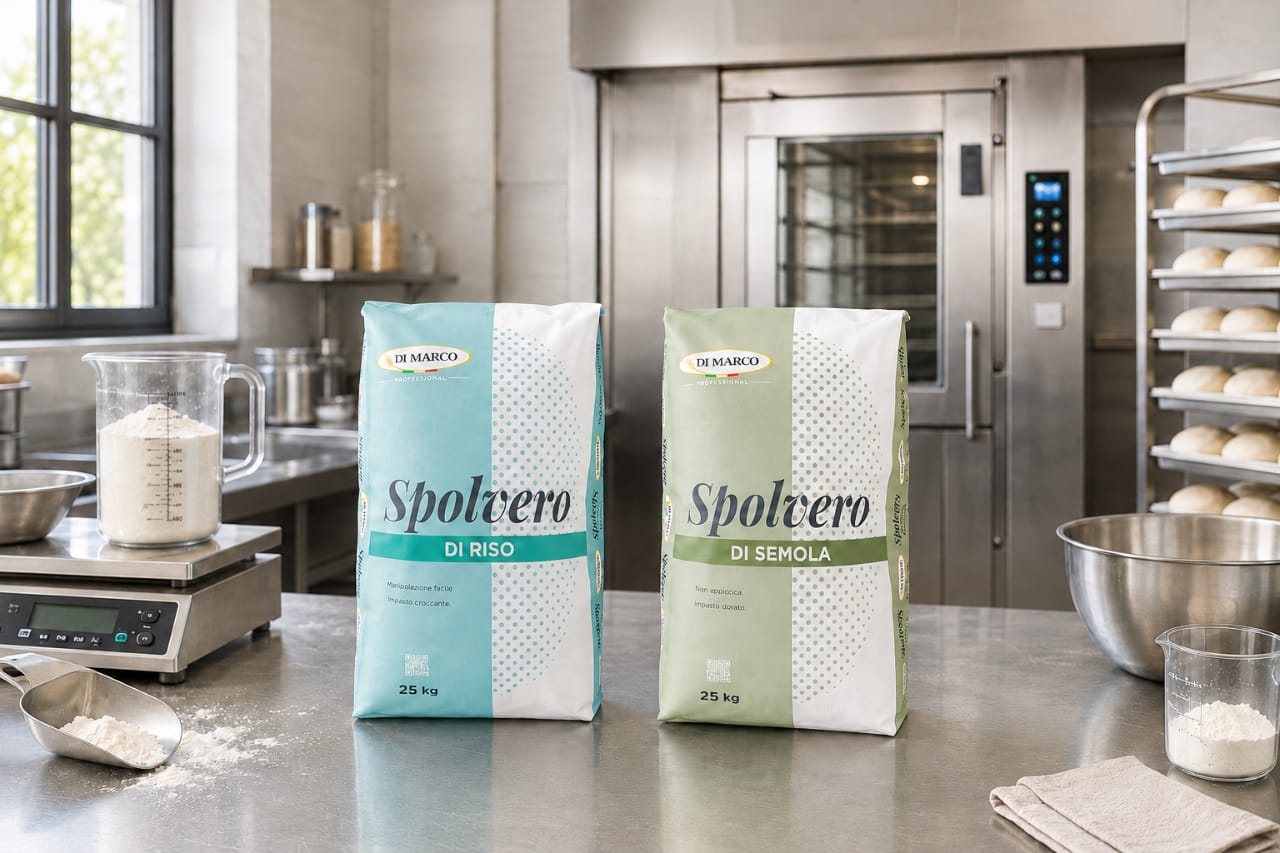
In addition to flour, water, yeast, oil, and an oven, among the tools of the trade we also find the flour for dusting, a key element for kneading the dough properly.
In a previous insight We've already seen what this is all about and touched on the Differences between rice flour and semolina flour. In this article, we go a step further by analyzing the role these products play in Handling High-Hydration Doughs and How to Use Them to make daily work more efficient.
The Key Role of Flour for Dusting in Pizza and Pinsa
Our flour for dusting It is the product used to create a a thin barrier between the dough and the work surfaces, such as workbenches, bins, and shovels. Its purpose is to limit the dough from sticking during the various stages of processing, making it easier to product design, handling, and management.
For professionals, this isn't just a practical matter. Choosing the right dusting method actually helps to preserve the dough's structure, minimize the amount of handling required, and streamline the entire production process. When it comes to pinsa, it's not as important as the choice of flour, but it is a factor that should not be underestimated.
A sprinkle of rice
Rice flour is known for its excellent nonstick properties and for its less tendency to absorb moisture. These features make it very effective for working with high-hydration and delicate doughs, as it helps to keep work surfaces clean and reduce the buildup of residue during cooking.
A sprinkling of semolina
The dusting of semolina is especially appreciated for its its grainy texture and the smoothness it gives the dough during processing. Compared to rice, it has a more rustic texture and a more pronounced presence in the final product, features that many professionals seek for specific types of dough and desired aesthetic results.
Why high-hydration doughs require more attention
In recent years, high-hydration doughs have taken on a central role in the world of breadmaking. The high water content in the dough, in fact, promotes the development of a lightweight, honeycomb-like structure, contributes to the product's fragrance and helps achieve results that are highly appreciated by consumers.
High hydration is one of the defining characteristics of Pinsa. Features such as its lightness, its crispy exterior, and its soft interior In fact, they also depend on the dough’s ability to retain and properly manage water throughout all stages of processing. It is a delicate balance, but one that contributes to to make Pinsa recognizable and appreciated around the world.
High-Hydration Doughs: The Challenges
While it offers undeniable advantages, high hydration increases the complexity of the dough-making process. In fact, a highly hydrated dough results in softer, more elastic, and more responsive to manipulation. During the kneading process, it tends to spread more easily and requires greater precision in movements to preserve its structure; furthermore, managing timing, temperature, and handling becomes even more important than with less hydrated doughs.
Added to these challenges is an issue well known to pizza makers and pinsaioli: the dough's greater tendency to stick to the work surface, paddles, and work surfaces. And it is precisely in this context that the choice of dusting plays a central role.
Rice or semolina flour: Which to Choose When Making Pinsa
We've already seen how rice powder stands out for its high nonstick performance and because it tends to absorb less moisture, while semolina is prized for its more pronounced presence during processing. In everyday practice, however, the choice between the two options It rarely depends on a single technical characteristic.
In fact, several factors come into play when making pinsa: the method used by the professional, the production volume, the organization, and the number of people involved in the various stages of preparation. For this reason, there is no one-size-fits-all answer, but rather an assessment that must take into account the specific needs of each business.
- One key point concerns the level of experience of the operators. An experienced pinsa maker achieves great results with both types of topping. For those trying pinsa for the first time, it might make sense to start with the remilled durum wheat semolina, and then assess over time—taking into account the work method adopted—whether and how to incorporate rice flour. In settings with multiple staff members or different skill sets, this assessment becomes part of a broader standardization process, which each organization will have to build upon its own direct experience.
- The production setup influences the choice. Those who produce a limited number of clamps per day often have the opportunity to manage each stage carefully and at a leisurely pace—a context in which both solutions work very well.
On the other hand, those who make dozens or hundreds of bases throughout the day must take execution speed into account and, consequently, understand how both ingredients behave: semolina tends to retain its nonstick properties on the work surface for longer; rice flour blends better with the dough and leaves a cleaner, more uniform surface on the finished product. In this case as well, the decision stems from direct observation of the company’s production process. - Finally, it is important to consider standardizing the end result. In a modern restaurant, the goal is not only to prepare a good pinsa, but also to consistently replicate its quality, appearance, and characteristics over time. The choice of dusting also contributes to this repeatability, becoming an integral part of the work process.
How to Use Flour When Making Pinsa
Using the dusting technique correctly means facilitate the various stages of preparation without altering the balance of the dough or compromising its distinctive characteristics. Here are a few tips that can make all the difference.
Use only the amount you need
When working with a particularly soft dough, it may be natural to think that a A larger amount of dust makes everything easier. In fact, excess product can accumulate on the surface of the dough or on the baking sheet without providing any real benefit to the baking process.
Spread it evenly
It’s not just how much flour is used that matters, but also how it’s distributed. In fact, an even coating of the work surface helps ensure smoother handling of the dough as it’s rolled out. On the other hand, localized buildup or uneven distribution can make the dough less uniform to work with, especially when working with high-hydration doughs that are particularly sensitive to conditions on the bench.
Pay close attention when transferring the load onto the shovel
The transition from the work surface to the shovel is one of the most delicate stages of the entire process. A high-hydration dough can, in fact, easily stick to surfaces, increasing the risk of deformities or difficulties when placing it in the oven. Here, dusting plays an important role because it helps make the transfer smoother and enables the professional to maintain control over the shape and structure of the dough.
Avoid excessive buildup and residue
During operation, especially in high-productivity environments, it is It is a good practice to check for residue on the countertop and the cooktop. Careful dust control helps keep the work area tidier and ensures greater operational continuity throughout the day.
Every detail counts
The quality of a pinsa does not depend on any single factor. It stems from the balance between ingredients, dough, proofing, rolling, baking, and professional expertise. Even the flour used for dusting—though often perceived as a minor detail—contributes to bringing out its best qualities.
At Di Marco, we have always worked to enable professionals and practitioners to to bring out the full potential of Pinsa. For this reason, in addition to our flour blends, we offer specialized dusting flours, training resources, and pre-baked bases designed to meet the needs of businesses with different organizational structures, production volumes, and levels of experience.
To overlook the role of dusting is to underestimate an element that is present at every stage of the process. On the contrary, using it correctly enhances the characteristics of the pinsa and helps ensure that the final result lives up to expectations.


 IT_IT
IT_IT  EN
EN  FR
FR  DE
DE  ES
ES