
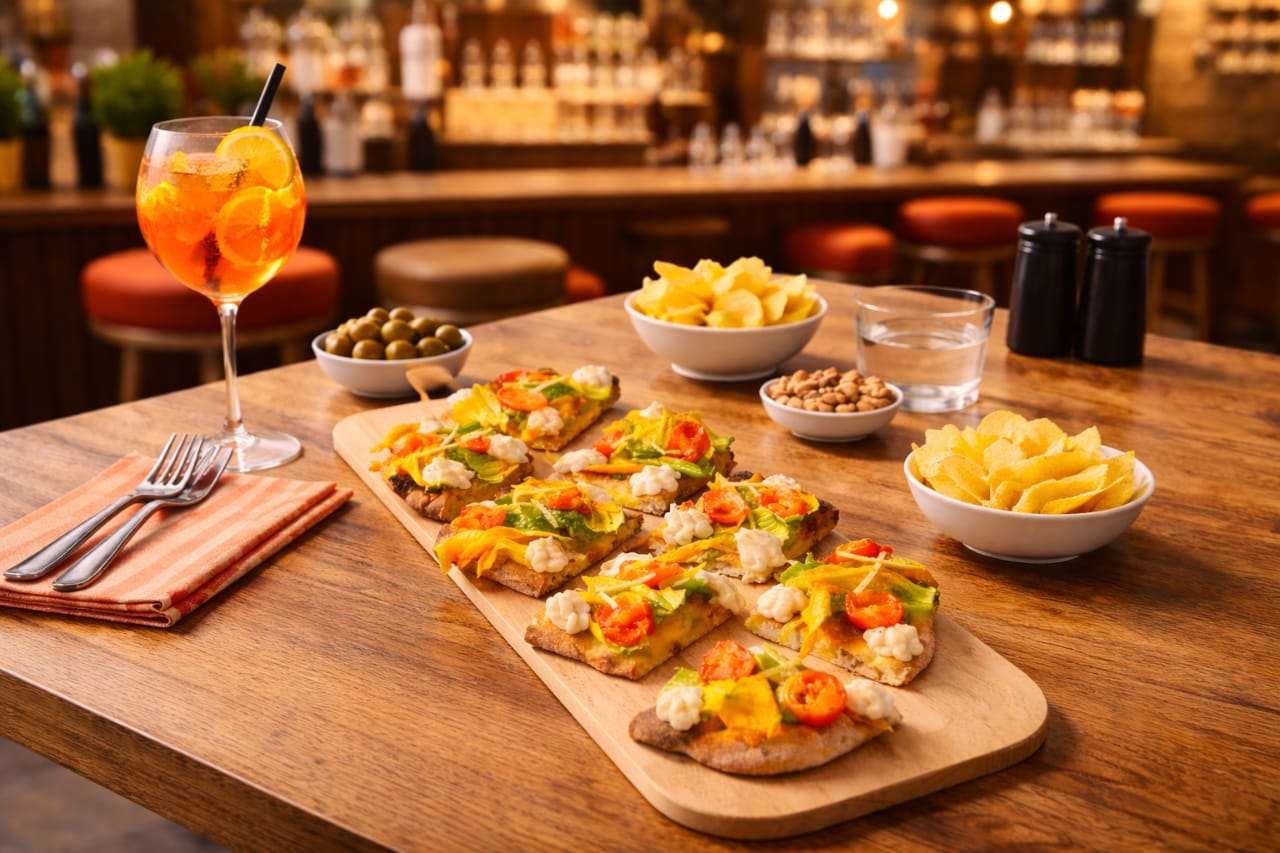
The relationship with the aperitif is changing. It is no longer an automatic moment made of habit and routine: today, those who go out are looking for something different and curated, capable of giving an extra reason to choose that very venue.
In this article we try to understand how people's habits are changing and find out why aperipinsa can be a valid response to this development.
Why aperipinsa is an ideal choice for restaurateurs
Second FIPE data, aperitif visits in 2025 were down from the previous year: -7.4% for lunch and -3.7% for evening ones.
This does not mean that the aperitif is in crisis, but that people are changing their approach. After years in which the offerings became standardized among fried foods, pizzas, and repetitive snacks, today's customer is much more selective. They go out less, and when they do, they want something that makes sense and provides satisfaction.
On the one hand, there are those who continue to seek simple and affordable solutions, But he doesn't want them trivial; on the other hand, there is growing interest in more curated proposals, even at the cost of spending a little more.
For the restaurateur, this is a challenge: the aperitif basic remains economically sustainable, but loses attractiveness, while more gourmet or ethnic offerings work, but bring with them complexity and higher costs.
In between is an interesting space: that of offerings capable of Maintain speed and lightness, but with a higher perceived quality. These are solutions that do not disrupt the kitchen, remain manageable, and allow you to raise the bar on appetizers Without exploding costs, striking a balance between demand and sustainability.
Obviously, we are talking about Of the aperipinsa.
Five reasons to consider Pinsa as an aperitif
Talking about aperipinsa makes sense because it responds exactly to this new balance between higher quality of proposal and economic sustainability. Here are some concrete reasons to evaluate it.
Pinsa intrigues and brings new customers
Pinsa is a well-known product, Innovative and not obvious as pizza is now. This makes it immediately more interesting in the eyes of the customer, especially in a context like the aperitif, where the desire to try something different is high. The customer knows more or less what to expect, but at the same time perceives an element of discovery.
At a time like the aperitif, this translates into a concrete advantage: more attention, more orders, and a real chance that That proposal becomes a recurring choice.
Raises perceived quality and breaks the routine
The second reason is related to quality, both perceived and actual. Compared to standard aperitif offerings, from fritti to pizzette, Pinsa is positioned on A completely different level starting with the appearance. It is more curated, more “flat” than accompanying, more consistent with the expectations of a customer who is much more selective than he used to be.
It is, of course, not just a matter of aesthetics. The difference is also felt on the palate: lightness, crispness, and taste contribute to a better experience than offerings in the same price range.
If visits for aperitifs are declining because many proposals are predictable, including something distinctive becomes almost a form of insurance. Not only does it help defend attendance, but it can also intercept new demand.
It does not complicate cooking. In fact, it simplifies it
If aperitif visits are declining, it makes little sense to introduce a new proposal that Complicates life in the kitchen, forces hiring of staff, is time-consuming and has an uncertain return.
Again, aperipinsa changes the rules of the game. There are two options.
- The first is starting with the flours and working the dough internally. Considering what we have just said, this route only makes sense for pizzerias and pinseries that already have tools and skills.
- The second, simpler and more widespread, is to use bases of Pinsa Di Marco precooked and artisanal. In this case, the impact is minimal: products keep for a long time (up to 18 months for frozen versions) and require only a few minutes in the oven. No special skills are needed, workflows do not change, and even the topping can be managed by optimizing ingredients already in the kitchen.
This also translates into more efficient inventory management: you prepare only when needed, reduce the risk of unsold inventory, and make the most of the raw materials already available, with A positive impact on waste reduction.
It is versatile and allows you to experiment without risk
Pinsa lends itself perfectly to the aperitif format: you can cut it into squares, strips or small slices and adapt it easily to the type of service you want to propose.
From here a world opens up. You can create several different flavors in the same Pinsa, build mixed proposals, or pair each variation with a specific cocktail or drink, making the appetizer more interesting and recognizable. If you want to raise the bar, you can work on sophisticated combinations; if you prefer to keep it simple, just a few well-chosen ingredients will do the trick.
The advantage is that you can test, vary, and figure out what works without complicating management. You don't have to prepare a whole Pinsa for each proposal: you can optimize quantities, reduce waste, and build a dynamic offering of simple bases and premium variants.
Costs under control and attractive margins
A final aspect concerns cost, which is often a key factor in menu choices. In the case of aperipinsa, many of the elements already seen play in favor: no new resources are needed, no special skills are required, storage is simple, and portion management minimizes waste.
The cost of the dish thus depends on only two components: the base and toppings. True, overall it may be slightly higher than some standard offerings such as fried foods, but so much so that it forces a significant increase in prices, which in itself leads to new risks.
On the contrary, the higher perceived quality makes it possible to sustain a slightly higher placement, so you maintain the current marginality while offering something more interesting. The result is positive: you intercept a more evolved demand, increase the average receipt and make the aperitif a more profitable time.


 IT_IT
IT_IT  EN
EN  FR
FR  DE
DE  ES
ES