
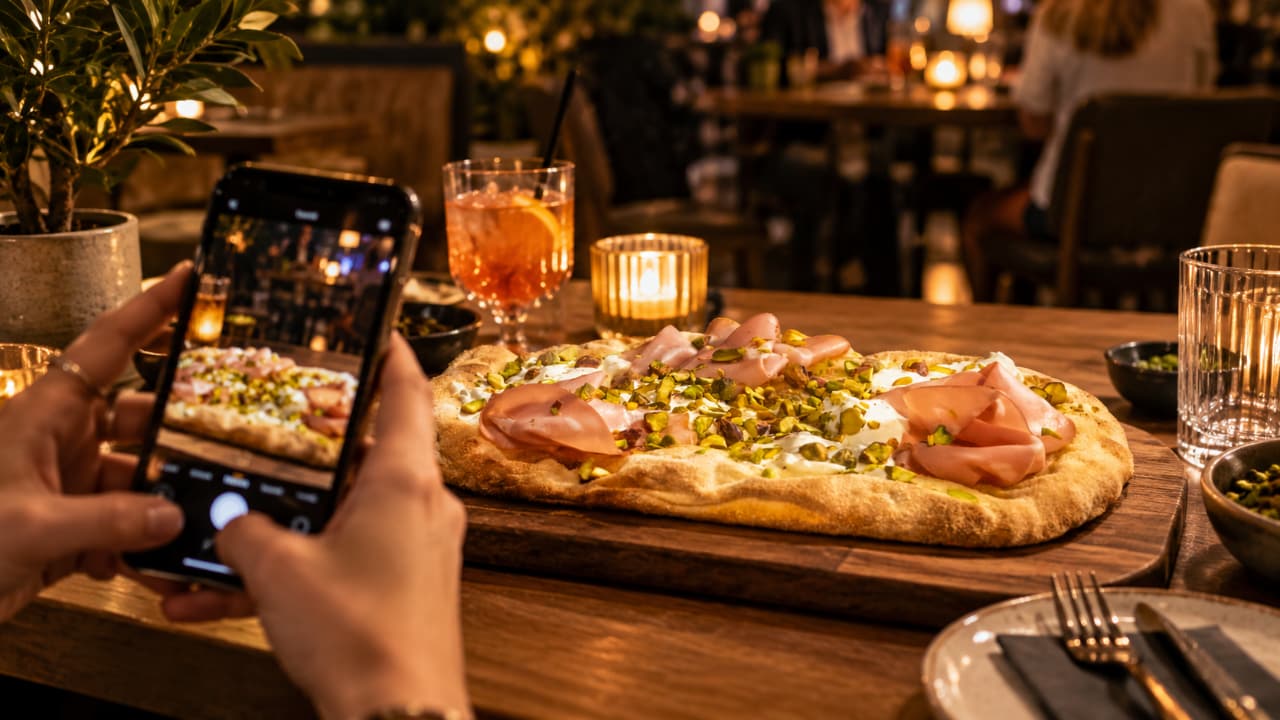
Trying a new restaurant begins before sitting down to eat. We study the reviews, look for the most-shared dishes on social media, look at the photos posted by customers, and We're trying to figure out what kind of experience the place has in store for us. It's not the glossy, perfect images that are convincing—the kind you see in tourist brochures, so to speak—but rather these ones, which are more credible the candid ones, taken during a dinner and shared with friends and followers.
For restaurant owners, this modern trend is a valuable opportunity: every photo posted by a customer can, in fact, become A spontaneous recommendation for the restaurant. Let's see how to make the most of it when pinsa takes center stage.
A Pinsa to photograph with your smartphone
A visually appealing pinsa entices customers to take pictures of it and share them, giving the restaurant a Visibility that doesn't require advertising spending. But since everyone is using this line of reasoning these days, simply serving up a dish isn’t enough to stand out—“a sight to behold”.
First, consider which device will be used to take the photo. Customers use smartphones, not SLR cameras. They are taken up close, in portrait orientation, often from above or slightly to the side, framing almost exclusively the pinsa. Its oval shape is an advantage: it fills the frame nicely and allows the ingredients to be clearly displayed.
Our Composition is essential: A well-balanced, distinctive pinsa naturally encourages customers to take a photo of it and share it. Start by avoiding common mistakes such as:
- Fillings of the Same Color, which tend to be confused;
- Distributed Ingredients without an order, which present a chaotic picture;
- Seals that are too small, which disappear.
It's a good idea to work on Use minimal sharp contrasts, leave some parts of the base visible, and identify an element that immediately catches the eye. It doesn't mean changing a recipe just to make it look good in a photo, but rather presenting it in a way that even a smartphone can tell the story well.
To verify this, simply take a photo of the pinsa at the table with a regular cell phone, under the actual lighting and conditions in which it is served. If the main ingredients are not visible in the image, or It's not clear what makes this proposal special, Even the customer will have a hard time explaining it.
Create a signature that is easy to read
Your goal isn't just to share the photo of the pinsa as widely as possible; you also want it to can be easily traced back to your establishment, because it's not a given that whoever posts it on social media will use tags or geotagging. In other words, You need a signature: You need to identify and include a detail that represents the restaurant and that customers can recognize across various menu items.
You have several options:
- One characteristic arrangement of the ingredients;
- One distinctive finish, such as a sauce applied in a recurring pattern or an ingredient always added after cooking;
- A recurring color contrast, created using two or three distinct colors that recur in the most representative Pinse;
- An iconic ingredient, linked to the local area or the restaurant’s identity, used in various ways but immediately recognizable;
- Quite simply, the name of the establishment is clearly visible. A personalized plate or cutting board makes it immediately clear where the photo was taken, even when the customer doesn't add a tag.
A small final gesture at the table, such as adding a cream, an aromatic oil, or a crunchy ingredient right in front of the customer: a moment that can spontaneously become the subject of a short video.
Encourage sharing without asking for it
Explicitly asking customers to take a photo of the pinsa and post it online is inappropriate. It’s more effective to make sharing easy and give it substance: Something to show, but also something to tell. In this case as well, we have a few helpful tips:
- Give the most distinctive pinse a recognizable name. A customer is more likely to mention Carbonara 2.0 compared to Pinsa with guanciale, pecorino, and egg. The name also makes it easier to find the dish in posts and reviews. Obviously, “carbonara 2.0” isn’t the best possible example, but the concept is clear: It takes creativity.
- Introduce the dish with a sentence that highlights its distinctive ingredient, its origin, or the reason for the pairing. This is material that the customer can use in the caption.
- Take advantage of formats designed for sharing. A pinsa with two distinct toppings or a tasting of several varieties They offer a more interesting subject than a single course. They work because they showcase variety and a friendly atmosphere—two aspects that customers naturally tend to photograph.
- Display the venue's social media handles. References to Instagram, Facebook, or TikTok may appear discreetly on the menu or the bill. They don't ask the customer to post, but they save the customer the trouble of having to search for the right profile if they want to do so.
- Share and engage. Reposting a customer's photo is helpful, but it's not enough: a reply, a thank-you, or a personal comment makes the customer feel acknowledged and They keep the relationship going even after the visit.
How to Tell If It's Working
The "likes" received on the restaurant's profile don't tell us much. To understand whether Pinsa is truly generating visibility, we need to look at what customers are posting and, above all, if that content has an impact on the venue. Keep the following points in mind:
- Count the organic shares, and, above all, distinguish them from content published by guest influencers or in collaboration with them;
- Don't just stop at notifications. Periodically search for the name of the establishment and check the public content associated with the location, relevant hashtags, and photos uploaded in reviews. Many customers do not tag the profile, But they still leave a reference that allows you to find the content.
- Take note of which Pins are photographed most often. If an item appears regularly, it can become a permanent fixture on the menu; if it’s never featured again but customers really like it, it’s worth it Review the presentation.
- Make a note of requests related to social media. If a customer asks, “”Do you still have that mushroom pinsa I saw on Instagram?", staff can log the report with a simple note. Over time, the number of requests makes it possible to see which content is actually influencing orders.
In this case as well, You don't need a complex system And you don't need to start with a team of social media specialists: at first, it's enough to just think things through with a view to sharing and gathering insights, and comparing them over time. If the results are positive, it will certainly be worth investing more in it.


 IT_IT
 EN
 FR
 DE
 ES
