
Pinsa continues to gain ground in the restaurant industry, but the growth in demand brings with it a responsibility: to ensure that customers a consistent experience that doesn't depend on who happens to be in the kitchen at that moment.
Ensuring consistent quality is an important issue because, as we well know, Pinsa isn't just a pizza with a different shape, but a product with a distinct identity that stems from the characteristics of the dough and the production process. When a restaurant doesn't use ready-made bases but starts from scratch with flour to make the dough, maintaining consistent quality is a matter of method. And since quality can't depend solely on the pinsaiolo's experience, because in real life there There are shifts, new hires, peak days, and vacations—we absolutely have to establish a method.
For our part, we can give you A few tips.
Train staff to standardize the process
Those who have been working with dough for years develop sensitivity and experience. Do you know when a mass responds well, when it's time to move on to the next step or when something isn't going as it should and needs to be corrected.
When a new employee joins the team, however, you can't simply tell them to observe and imitate what they see: they must have precise references, especially during stages where small variations can lead to different results.
Which metrics should be shared with the entire staff?
The standard must cover at least those elements that affect the behavior of the dough and the final result. That is:
- What Flours to Use, because they are the starting point and determine key characteristics of the dough;
- The recipe and measurements, which must be reproducible to avoid ad-hoc corrections;
- Proper Hydration, which is essential for the texture and workability of the final product;
- Drafting Guidelines, because the gesture directly affects the form and structure;
- Cooking Parameters, which must be connected to the oven and the equipment;
- Control Criteria, that is, how to determine whether the dough and the finished product meet the standard;
- Environmental Conditions During Processing, because the temperature and humidity in the lab can affect how the dough behaves and therefore require careful attention to ensure consistent results.
Keep in mind, there's no need to turn your kitchen into a lab full of procedures. But it's just as important that the determining variables are not left to chance.
From Flour to Dough: It All Starts with the Raw Ingredients
If you start with flour, standardization inevitably begins there. To think that all you have to do is take any flour and apply a generic “Pinsa Recipe”… means neglecting one of its fundamental elements.".
Corrado Di Marco's original recipe actually comes from A study on flour blends, hydration, and proofing. The combination of wheat, rice, and soybeans is one of the distinctive characteristics of the dough; Generally speaking, wheat contributes to the structure and firmness of the dough, rice adds lightness and crispness, while soy contributes to the softness and overall characteristics of the dough.
For a professional venue, therefore, Choosing the right flour—one that maintains a consistent base mixture—is the first step in ensuring the desired result.. Changing the raw material and expecting the curing times, water content, and workability to remain the same is a risky shortcut.
Hydration and rising times work together
Once the blend has been chosen, other variables come into play. The key point to convey to new staff here is that these They do not work separately.
Hydration affects texture and on how the dough is handled; the type of yeast and the proofing times influence its development. If one of these conditions changes, the process may not react exactly the same way as it did the day before. These elements must be defined quite strictly; For example, using sourdough starter and allowing the dough to rise for 72 hours at a specific, well-defined temperature.
Here, a new operator needs to know what requirements to meet and, above all, When a Change Deserves Attention instead of instinctively compensating by adding water, flour, or extending the cooking time.
How to Tell If the Dough Has Turned Out Right
Just following a recipe isn't enough if then No one knows how to assess what is right in front of them. An important part of the training must therefore be devoted to the ability to observe and touch the dough. Texture, elasticity, rise, and response to handling become practical indicators that an experienced bread maker can show new employees during their orientation, including with the help of visual aids such as video tutorials on kneading, rolling out, and baking available on our Instagram profile.
This is probably one of the steps that’s hardest to convey through a simple technical sheet or a theoretical lesson. You can specify an amount of water or a time, but you also have to demonstrate it in practice What does the dough look like when the process is proceeding correctly? And what signs, on the other hand, suggest that something isn't going as it should?.
Drafting: Few Standards, but Very Concrete
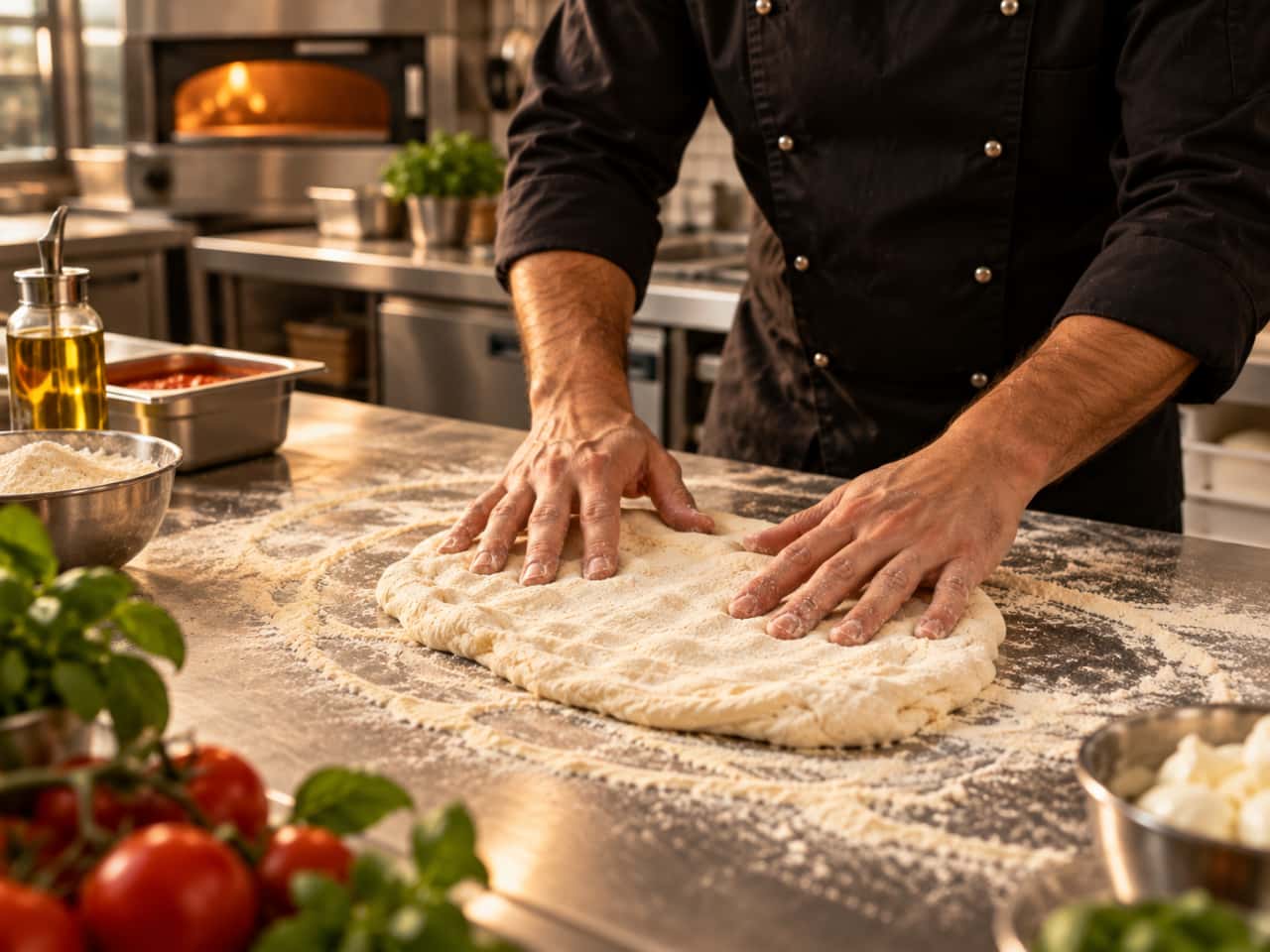
Shaping is a stage where the difference between an experienced maker and a novice is even more evident. In the case of pinsa, moreover, it serves not only to give the product its shape, because Handcrafting and the act of “pinsare” are part of its identity. Shaping the dough with the fingers to create the characteristic bubbles and the elongated oval shape is a fundamental part of the process.
Cooking: Teaching People to Understand the Product, Not Just the Timer
Even at this stage, it's easy relying too much on numbers and automated processes. Temperature and baking time are key factors, but they aren't enough on their own, because how the pinsa turns out depends on the oven used and the actual baking conditions.
An electric, gas, or wood-fired oven does not transfer heat in the same way and may react differently even when the load, the pace of service, or the number of Pinse placed inside at the same time changes. For this reason, staff should not only learn “at what temperature” or “for how many minutes” to cook, but be familiar with the oven used in the restaurant and understand how it behaves in different situations.
In other words, You have to check out the pinsa. The development of the base, color, crispness on the outside, and internal texture are all factors that help determine whether the baking process is producing the expected result. It is precisely these indicators that the most experienced pinsaiolo should teach new employees to recognize, by supplementing the procedure with a hands-on product inspection.
The Most Common Mistakes Made by New Employees and How to Avoid Them
When a new person joins the kitchen staff, it’s only natural to make a few mistakes. That’s not the problem—the problem is failing to notice them and letting them become a habit, which is then difficult to break.
For this reason, in addition to explaining what to do, it’s best to make things clear from the start What are the most common errors, and what signs should prompt an inspection?.
Without claiming to be exhaustive, here are a few:
Adjusting dosages “by eye”
If the recipe has been defined and validated, water, flour, yeast, and other ingredients They should not be corrected instinctively. If something doesn't add up, it's best to stop and figure out why.
Adjust an unbalanced dough by adding water or flour
A dough that's different from usual can be due to several factors. Trying to fix it without investigating the cause It risks masking the problem without solving it.
Arbitrarily changing the rising times
Bringing forward or extending a phase because It looks like it's ready may affect the result. The specified times must be followed, and any anomalies must be evaluated—not automatically compensated for.
Applying it too aggressively or unevenly
Excessive pressure or uneven distribution of the dough can compromise the structure built up in the previous steps and result in bases that differ significantly from one another.
Always use the same cooking times regardless of the oven or the amount of food being cooked
The timer and temperature are guidelines, but not absolute automatisms. Oven behavior varies depending on the equipment and operating conditions, so the product must always be monitored.
Education remains essential, but in this case Hands-on guidance is worth more than any manual: Seeing, trying, correcting, and repeating allows new staff to quickly develop a method and gain confidence. With clear standards and a little practice, the process becomes easier to manage and the quality that is easiest to maintain over time.


 IT_IT
 EN
 FR
 DE
 ES
