
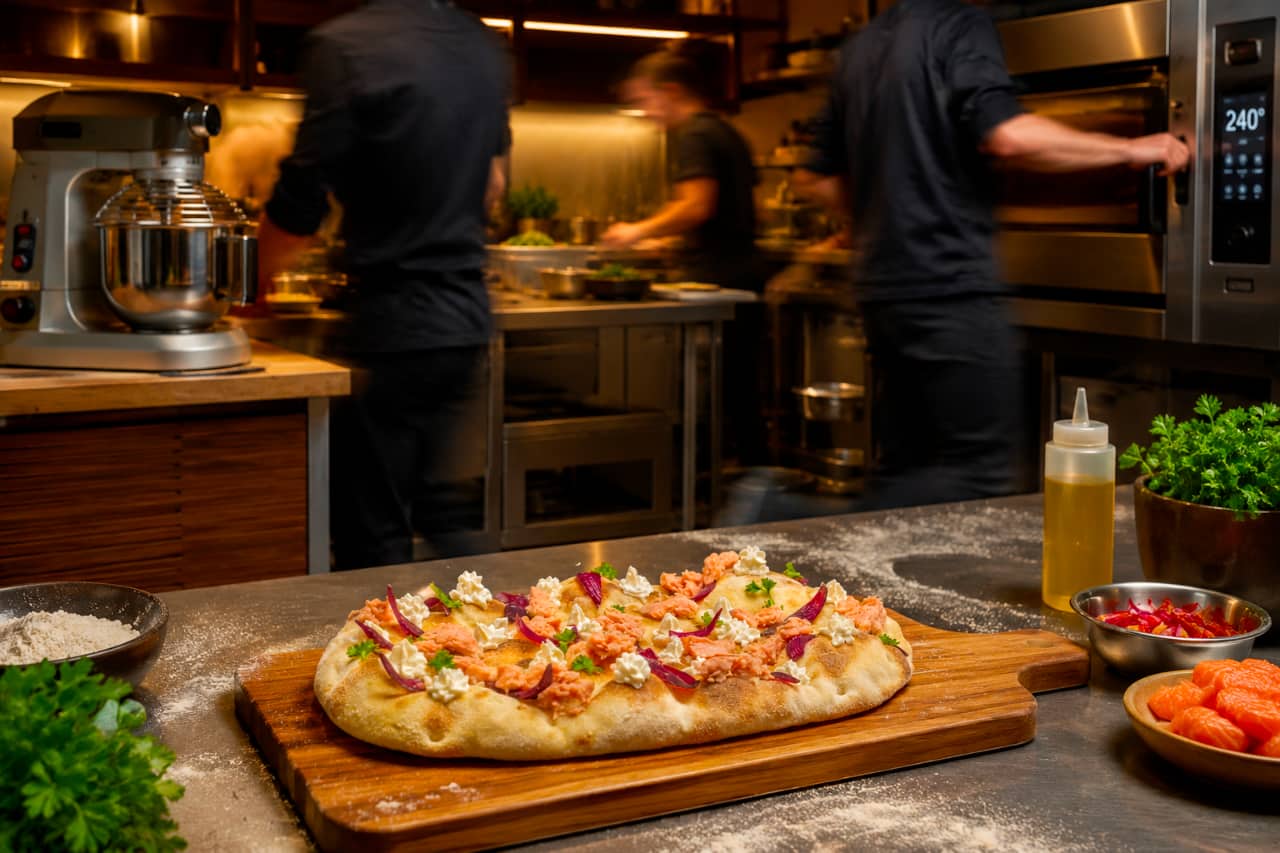
September is the time when restaurant owners review the menu and evaluate new opportunities, including the introduction of pinsa. The reasons are clear: its success in recent years, the versatility of pinsa, and the ability to serve it at various times, From appetizers to the main course.
The challenge is Turn interest into a sustainable investment. If you're not very experienced, you might think that the investment is simply the cost of raw materials, But you should know that's not the case. Instead, consider equipment management, space organization, staff training, and initial inventory, as well as the choice between in-house production and ready-made bases as well as on the impact of the new proposal on kitchen operations.
There is no one-size-fits-all solution. What and how much to invest depends on where you're starting from and the goal you set for yourself. So let's consider three fairly common cases.
Already-equipped facility: the biggest investment is in skills
If the restaurant already has an oven, a dough mixer, and workspace, add Pinsa to the new menu requires a modest financial commitment, but it would be an oversimplification to think that this is enough Buy our flours and add a few items to the menu to celebrate winning the game.
Having the equipment already is certainly an advantage, but You also need the right skills to create a high-quality product that is recognizable and stands out from the competition.
Our advice is to work on three fronts:
- Train staff on the product and the method, ensuring that existing equipment and processes are compatible with the dough preparation, proofing, shaping, and baking of pinsa. It is important to always remember that Pizza and pinsa are not the same thing.
The goal is not to revolutionize cooking, but integrate production without causing delays or inconsistent results.
- Assign the pinsa a specific role on the menu through a variety of shapes and fillings that They do not match the pizza offer. Pinsa can be, for example, a dish to share, an option for an aperitif, or a base for sophisticated combinations.
- Clearly communicate the difference, both on the menu and through the waitstaff. If the customer understands the essence of the pinsa, it is easier to highlight its appeal, identify new needs, and reduce the risk that the pinsa simply remove orders from the dishes already on the menu.
Here, the return on investment depends not so much on savings on equipment as on the the ability to transform the resources you have into a new offering, distinctive and easy to integrate into the service.
Restaurants and Pubs: Start with Pre-cooked Base Ingredients to Eliminate Risk
For a classic restaurant or a pub, The Basics of Pinsa Pre-cooked products are the most accessible way to introduce a new product. The advantages are clear: starting with the basics does not require a production line and significantly reduces the time needed to acquire specific skills. The initial investment is minimal and A trial period allows us to gauge customer interest before expanding the service.
Even in this case, however, the investment does not limit them to purchasing just the bases.
- The staff is familiar with the product and does he know how to finish the preparation correctly?
- The room is capable of Should I tell the story?
- The selected proposals are consistent with the audience already served Or can they attract new customers?
To accelerate your return on investment (ROI), it’s best to focus on three areas:
- Train the kitchen and dining room staff on the product. If you use pre-baked bases, the investment in training will be lower than that required for establishments that make their own pinsa in-house starting from flour. However, it is still necessary to train staff on the proper cooking, finishing, and presentation and on how to present the product to the customer.
- Designing an offering that aligns with your audience, rather than simply adding a generic item to the menu. In a pub, pinsa can be served alongside drinks or as a dish to share; in a restaurant, it can be served as an appetizer, a casual alternative, or a dish paired with specific items already on the menu.
- Investing in Communication, because those who are already familiar with the place He's unlikely to find out about the new offer unless he has a reason to do so. Menus, digital channels, trial offers, and dining room staff should highlight this new feature and explain what it adds to the experience.
The Limited Investment and the ability to roll out the service gradually shortens the payback period; however, for this advantage to translate into tangible results, it is essential to allocate a small budget to the developing the product offering and generating demand.
Open or renovate a restaurant with a focus on pinsa
The third scenario applies to those who open a business from scratch or renovate an existing one and choose to Give the Pinsa a prominent place on the menu. It doesn't have to be the only product offered, but it must make a recognizable contribution to the project's identity and be one of the reasons why customers choose that particular establishment.
The investment is more complex than the previous cases. In addition to equipment for mixing, proofing, storage, and baking, other factors come into play, such as space planning, staff training, recipe development, workflow organization, and Supplier Selection. In addition to these items, there are those related to positioning: visual identity, communication, launch, and activities necessary to promote the proposal.
Here, too, The project's economic viability depends on several factors:
- Design the production line based on expected volumes, selecting equipment and space that allow for to operate continuously without making the initial investment too large. In-house production can also be developed in phases, provided that the initial choices do not limit its evolution.
- Invest in a recognizable identity, which immediately conveys the role of the pinsa and the kind of experience the restaurant promises. Marketing isn't just about promoting something new: It must generate anticipation and reach the most suitable audience and turn specialization into a distinguishing feature.
- Take full advantage of the versatility of the Pinsa with 100%. The product invented by Corrado, Di Marco, can be enjoyed in a variety of settings—from individual servings to sharing, from appetizers to full meals, and even for dessert. A well-designed product line allows you to use just a few ingredients, Carefully monitor inventory and increase sales opportunities without unnecessarily increasing the number of production runs.
- Supplement in-house production with a stock of pre-cooked bases. A hybrid model makes it possible to adjust daily production to match typical volumes and to use ready-made bases in the times of peak traffic or when demand exceeds forecasts. This allows the restaurant to keep in-house production at the heart of its offerings, while also relying on a reserve that ensures prompt service.
The return on investment therefore depends not only on the profit margin of each Pinsa, but also on the ability to attract customers to the restaurant, maintain the average check, and make the menu less easy for competitors to replicate. At least in the short term.
How to Calculate Return on Investment
Once you've identified the scenario most relevant to your business and the related investment items, such as Can you estimate how long it will take to retrieve them?
The first step is to add up the initial costs incurred to introduce the Pinsa. Depending on the situation, these may include the purchase or upgrade of equipment, training, menu planning, initial inventory, promotional materials, and launch activities.
Next, Calculate the average profit margin for each Pinsa sold. From the price, you must subtract the direct and indirect costs that recur with every order: the pre-cooked base or flour and other dough ingredients, toppings, packaging, energy used for preparation, any delivery fees, and the labor required to prepare and serve the pinsa. However, you don't need to subtract the cost of the oven, training, or launch again, because it is precisely that investment that the profit margin generated by sales will have to recoup.
At this point, the calculation is simple:
- Initial Investment ÷ Average Margin per Pinsa = Number of Pins to sell to recoup the investment.
By dividing the profit by the average sales for each week or month, you can calculate a preliminary estimate of the return time. It is best to develop a conservative scenario, especially in the initial phase, and consider only the truly incremental sales: If the Pinsa replaces a dish that the customer would have ordered anyway, the actual profit is equal to the difference between the two profit margins.


 IT_IT
 EN
 FR
 DE
 ES
